
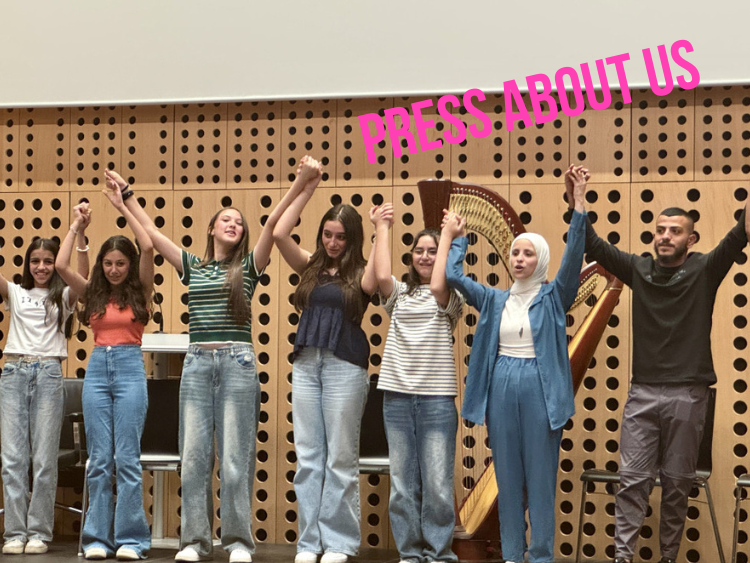
Slovenia with young people for peace: music as the language of peace
The project SIT DOWN – Peace Child is held in honour of the 80th anniversary of the founding of the United Nations (UN) and the end of the Second World War. In a ten-day creative camp, young people create the musical Peace Child, a story of cooperation, dialogue and the future they want. What makes the project special is that young people co-write the lyrics and music themselves, discussing key global challenges – from peace education, climate change, safe migration and the use of artificial intelligence to questions of love, ...
The project SIT DOWN – Peace Child is held in honour of the 80th anniversary of the founding of the United Nations (UN) and the end of the Second World War. In a ten-day creative camp, young people create the musical Peace Child, a story of cooperation, dialogue and the future they want. What makes the project special is that young people co-write the lyrics and music themselves, discussing key global challenges – from peace education, climate change, safe migration and the use of artificial intelligence to questions of love, acceptance and solidarity.
The highlight of the Slovenian part of the project will be the premiere of Peace Child on 23 August on the stage of Križanke as part of the Ljubljana Festival, with the international presentation on 23 October at the Wiener Konzerthaus, on the eve of UN Day. Both concerts will be accompanied by business forums organised by SPIRIT Slovenia and partners, linking art, diplomacy and the economy in a shared vision of sustainable development.
Art and advocacy hand in hand
Alongside the concert work, the young people also took part in a three-day advocacy workshop programme (14–16 August), where 24 children and young people explored how they themselves can help shape a fairer, safer and sustainable future. They learned how the United Nations works, discussed the UN Declaration on Future Generations and identified five priority topics for their generation: peace and security, safe migration, a sustainable environment, inclusive societies and intergenerational justice.
They practised negotiation skills, discussed the challenges of the digital age after watching the documentary The Social Dilemma and designed their own advocacy campaigns on global challenges. The programme ended with a World Café, an open discussion in which young people looked for paths to shared solutions and realised that the future can only be built through cooperation, solidarity and dialogue.
Amwaj – waves of hope from Palestine
Among the most moving stories of the project is the participation of the Palestinian youth choir Amwaj (meaning "waves"). Amwaj was founded a decade ago in Bethlehem and Hebron by Italian musician Michele Cantoni together with his wife Mathilde Vittu, a professor at the Paris Conservatoire. As Cantoni, who has lived in Palestine for twenty years, says, "music is one of the most powerful forms of dignity and resistance" – and that is why it endures among the children even as violence and restrictions escalate daily.
In its first decade Amwaj has become much more than a choir – it has become a symbol of artistic resistance, hope and dignity. Around 70 children and young people take part, from communities separated by walls and checkpoints; some walk several kilometres to rehearsals when roads are closed. Despite these circumstances, Amwaj offers high-quality music education and international exchanges, and is training a new generation of young conductors and teachers. Their repertoire combines different languages and traditions, and many works were written specially for them and premiered at their concerts. When they take the stage, their voices tell of the reality of occupation and uncertainty, but also of solidarity and hope.
The participation of the Palestinian choir; of the singers of the SUPERAR BIH choir, whose voices spring from painful experiences of war and displacement; of Ukrainian musicians whom the Slovenian Youth Orchestra, under the artistic direction of Živa Ploj Peršuh, enabled to continue their music education in Slovenia after the outbreak of war; and of all the other young artists from the United Kingdom, Turkey, Italy, Japan, Hungary, Pakistan, Montenegro, Serbia, Croatia, Spain, the United States, Russia, France, Romania and Wales carries a precious message to the world. This is not just a cultural event but an expression of cultural and science diplomacy that transcends political and geographical borders, builds bridges between people and opens space for dialogue. It is an act of humanity and solidarity that gives young people the chance to speak through music with the most powerful message of our time: peace is possible if we create it together.
Source: Gov.si
Authors:
Date: Mon, 18 August 2025
Link: Slovenia with young people for peace: music as the language of peace, 18 August 2025